


Reaching 127 million viewers is a triumph of media buying, but ensuring they remember your brand is a triumph of neuroscience. Our unbi audit of five key spots shows that high engagement does not always lead to memory encoding.
The "Vampire Effect" in Real Time
Many brands this year suffered from the Vampire Effect, where high-arousal creative elements, like intense action or celebrity drama, monopolize the brain's limited working memory. When this happens, the brain physically filters out brand logos and product cues.
The Winner: Kellogg's Raisin Bran
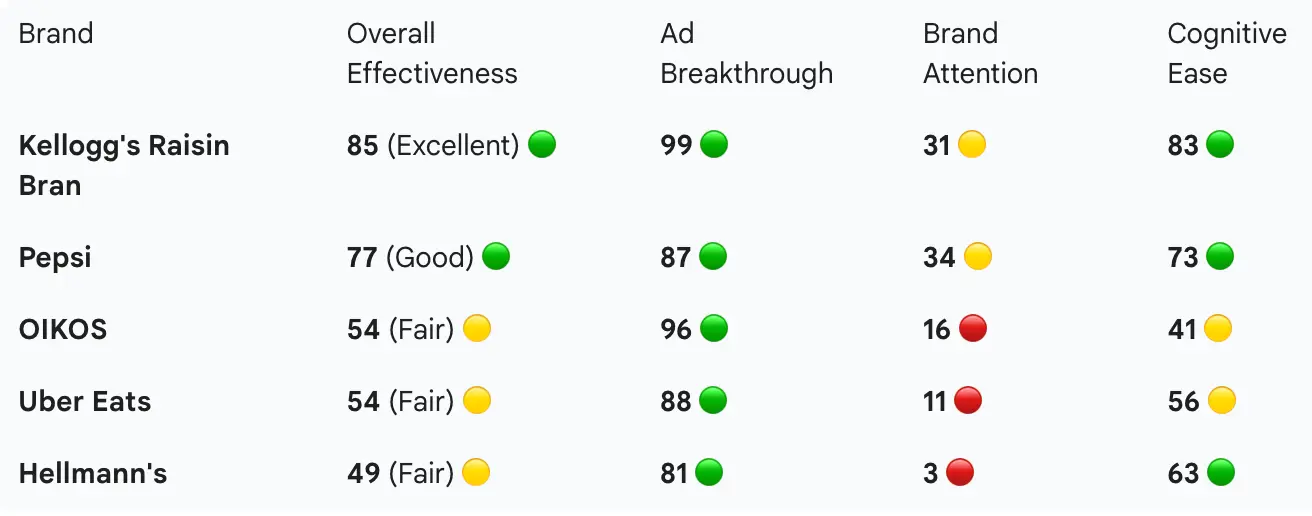
Kellogg's Raisin Bran provided the masterclass in balanced branding. By pairing a study-high Ad Breakthrough score of 99 with a Brand Attention score of 31, they proved that high energy doesn't have to be a distraction. The predictive heatmaps show attention consistently returning to the product, resulting in a Cognitive Ease score of 83, meaning the brain was never too overwhelmed to notice the brand.
The Lesson: Hellmann's
Hellmann's serves as the ultimate warning of the Vampire Effect. While the ad broke through the clutter with an 81 score, its Brand Attention plummeted to a 3. The heatmaps reveal that viewers were locked onto the dramatic restaurant scene, entirely bypassing the brand cues. In neural terms, this $8 million spot was a gift to the audience’s entertainment, but a "ghost" for the brand’s memory.
The Competitive Middle Ground
Pepsi (The Choice): Pepsi earned the highest Brand Attention (34) in our group. By putting the product in constant close-ups alongside a familiar asset, they created an immediate neural bridge to the brand.
OIKOS (The Big Hill): While OIKOS hit a massive 96 Breakthrough score, the rapid-fire scene changes and high-speed action made it difficult for the brain to keep up. A study-low Cognitive Ease of 41 suggests that the pace of the creative left only 16 on Brand Attention.
Uber Eats (Hungry for the Truth): This is where the Vampire Effect hit hardest. Despite an 88 Breakthrough score, the celebrity narrative cannibalized the brand, resulting in a low 11 for Brand Attention.
The Takeaway
The first 1.5 seconds are where your media budget is won or lost. If your distinctive brand assets aren't in that initial attentional path, your audience will remember the story, but they'll never credit your brand for it.

.webp)
.jpg)


