

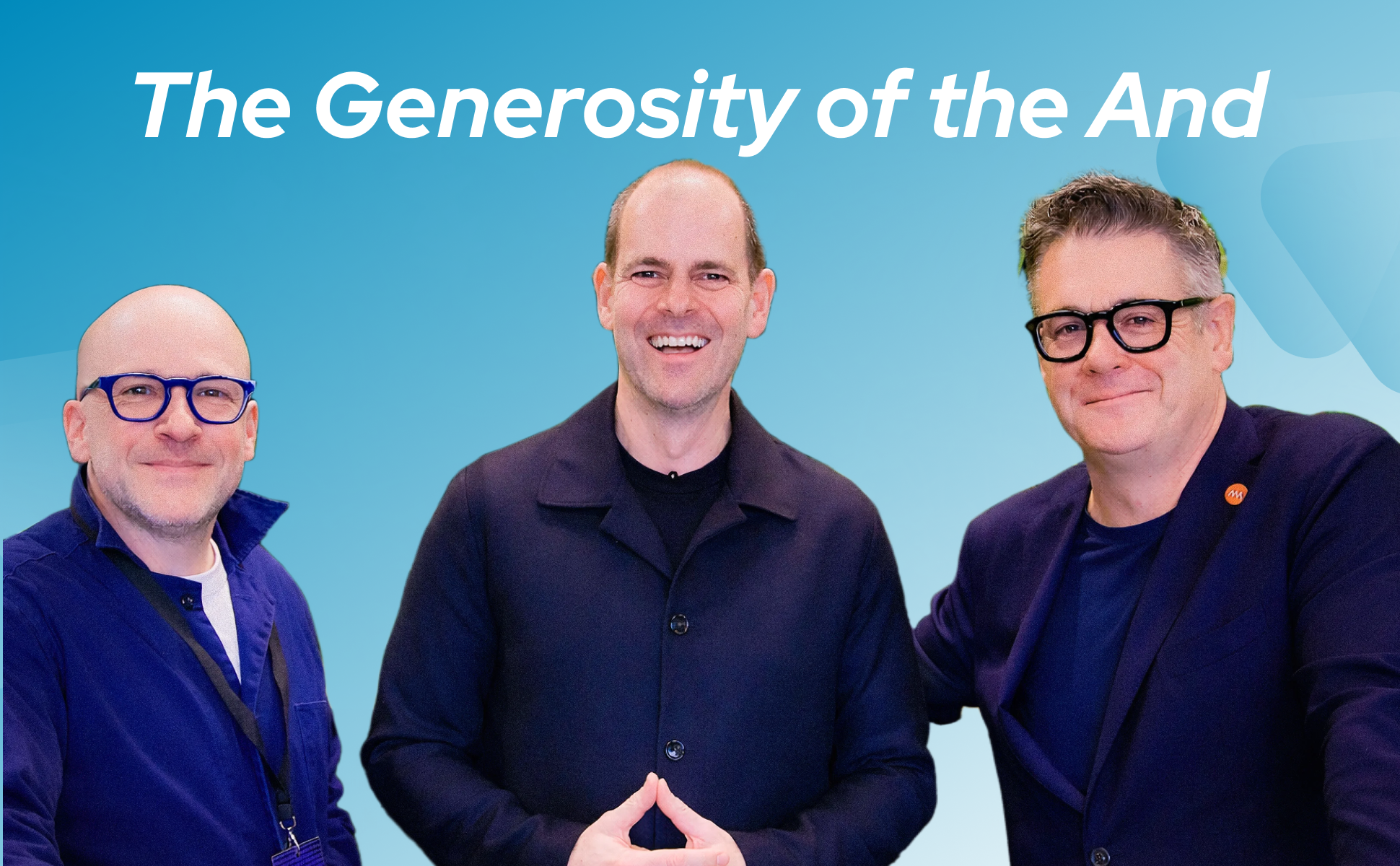

The marketing industry is locked in a cycle of self-inflicted polarization, constantly chasing trendy tactical shifts while ignoring commercial reality. In this high-authority discussion, marketing professor Mark Ritson and Google’s Managing Director Martijn Bertisen break down the critical paradigm of "Bothism"—the operational capacity to reject false dichotomies and simultaneously leverage competing marketing ideas. From the structural displacement caused by synthetic data to the psychology of pricing modeling, this interview outlines how elite marketing departments must evolve to earn the commercial respect of the board.
At alpha.one, our applied methodology directly mirrors the principles of Bothism. We reject the systemic divide between intuitive creative development and cold predictive numbers. True empirical marketing treats rigorous strategic planning as the core foundation, using automated diagnostic modeling as the precise execution mechanism. When execution is treated not as a substitute for thought but as an amplifier of baseline strategy, marketing shifts from an unstandardized craft to a reliable revenue driver.
Key Takeaways (TL;DR)
- The Bothism Imperative: Sustainable business growth requires executing contradictory frameworks simultaneously: long-term brand building and short-term performance, qualitative tracking and quantitative scaling.
- The Synthetic Revolution: Automated synthetic data models have reached structural superiority over slow consumer panel research, enabling rapid scenario planning and hyper-accurate simulation modeling.
- Profit Over Revenue: Marketers routinely mistake volume and gross revenue for performance. True business health is governed entirely by pricing psychology and operating margins.
- The Training Crisis: Marketing suffers from a profound deficiency in formal, standardized professional training compared to adjacent business disciplines, directly eroding board-level influence.
What is Bothism in Marketing?
Bothism in marketing is the strategic framework that rejects false binary choices in favor of integrating opposite or conflicting marketing principles simultaneously. Pioneered contextually by Mark Ritson, Bothism mandates that successful firms execute both long-term brand building and short-term performance marketing, balancing qualitative market orientation with rigid quantitative measurement to maximize total profitability.
Dismantling False Binaries: The Strategic Architecture of Bothism
Mark Ritson has built a career on telling marketers what they don't want to hear. From his perch in Tasmania, geographically remote from the ad-land circuits of London and New York, he has spent the past decade dismantling fashionable nonsense with the cheerful viciousness of a man who never had to worry about being invited back. The Metaverse? Bullshit. NFTs with Gary V and Paris Hilton? "Fucking madness." QR codes as the future of marketing? See above.
Which is why, when Ritson takes the stage at Google Think Consumer to talk about artificial intelligence, the audience is leaning forward. Is AI one of those things he's about to throw under a bus? After a quick "Hello Fuckers", it turns out. It isn't.
"AI is clear," he says. "This is a different thing."
The keynote that preceded our conversation was an argument for what Ritson calls Bothism: the rare capacity to hold two oppositional ideas in the same head and still operate. He cribs it half from F. Scott Fitzgerald and half from Jim Collins, who urged great companies to reject the "tyranny of the or" in favour of the "generosity of the and." In marketing terms, that means qual and quant, brand and performance, distinctiveness and (relative) differentiation, the 95 and the 5. The industry, in Ritson's telling, has spent a generation losing its mind to false binaries. Bothism is the cure.
The conversation quickly shifts from theory to today's most influential "both" of all: the one between marketing fundamentals and the AI revolution, now slowly folding itself into every workflow.
The Automated Squeeze: AI, Synthetic Data, and the Death of Low-Value Work
Ritson is unfussy about where AI is going to bite first, and it isn't the place most marketers are looking.
"It won't be that interesting in advertising," he says, "but that's just because the industry is obsessed with ads. Making an ad with a creative agency isn't the most expensive part of marketing, and AI will struggle to beat a crazy Dutch creative agency anyway."
The bigger change, he argues, will be in automation, strategy, and synthetic data. He cites an Anthropic study of 8,000 professions that ranked marketers fifth for substitutability. "The 65% number is pretty good," he says. "It means a general squeeze: fewer junior jobs, fewer senior moves, until one day we wake up as a smaller, different discipline."
What gets him animated is the modelling possibility. "Synthetic data has now reached a point where it is superior to consumer research. Not just faster and cheaper, but more accurate. It opens the door to building brand plans humans could never build. We can run 400 brand plans and see how they play out."
Martijn Bertisen, from inside Google, frames it a bit more cautiously. "I think we're in peak uncertainty," he says. "It's difficult to project where it goes. Marketers in departments right now are probably a bit disappointed with what AI offers today, because the promise is so vast."
He warns of what he calls the one-strike problem. "There's a risk where you use a tool like Veo 2 once, it isn't great, and you say you're done with it. But the model gets better exponentially. At Google, we see it every day. The idea of turning an idea in the morning into a campaign in the afternoon is closer than it's ever been."
Architect Note: Insert Visual 1 here to explicitly contrast the structural components of tactical automation against foundational strategy execution.
For Ritson, the most underrated unlock is access. B2B companies, he points out, were always a bit handicapped by data problems. The total number of customers was few, research was thin, and market orientation was something practised more in slide decks than in real life.
"American B2B companies, for instance, the big problem was always that they didn't have much consumer data. Suddenly, this opens that world."
He nods toward consumer tools that any marketer can now reach. "You can do it very nicely. You can run basic synthetic research and do a conjoint in about four or five minutes. It's not as advanced as what companies like Evidenza do, but it's still possible for a marketer to go, 'I wonder what price point we could charge,' and just do it."
The implication hangs in the air: the marketers who get good at this will look very different from those who don't, and the gap will open faster than most departments are prepared for.
YouTube’s Quiet Ascent and the Back-End Battle for Attention
Ritson has watched Google travel the standard disruptor's route, from insurgent to incumbent to, briefly, embattled.
"I like this about Google because the disruptor is now a mature company," he says. "You boys are going through what everyone else went through. There was that moment where people said AI would kill search. It clearly didn't."
He points to Warren Buffett's recent accumulation of Google stock. "He can see who wins the back-end war of cloud and silicon. They have the chips to compete with Nvidia. DeepMind has three Nobel Prize-winning scientists. They're connecting brands to consumers across the full journey."
Then he says something that would make a YouTube product manager smile: "There could be a time where YouTube becomes more valuable than search. It is so uniquely placed in that sweet spot between traditional TV and digital video. It had a magical position from the start."
Bertisen, who would be a poor GM if he disagreed, doesn't. He talks instead about what it has been like to lead over the past two years. "When ChatGPT came out, we found ourselves responding to a technology we should have been leading on. But now it feels better. We're back in our sails, with a velocity of launches and a transition into what was 'search of old' and 'search of new.' It's on a knife-edge, but the momentum is there."
What's changed, Ritson suggests, is less the model layer than the application layer. "A model is great, but how do you productize it into consumer products and campaign tools that a marketer can actually use? That's where the velocity and the rewiring of Google's internal organs has happened."
Pricing Psychology over Sales Volume: The Ultimate Leverage of Profit
For a man with strong opinions about how marketing organizations should be led, Ritson has zero interest in leading one himself. He tells a story he hasn't told publicly before: being offered a CMO role at a US retail giant. It didn't go through. If it had, would he have been good at it? He doesn't pretend.
"I'm not sure I could do it. I don't like leading anyone or managing anything. My idea of hell is having to run a team. It's a bit of a limitation, but I have no interest in behaving in a group."
That instinct, autonomy over hierarchy, seems to have shaped his business. The Mini MBA in Marketing now runs tens of thousands of students annually, with no lecture theatres, no traditional graded exams, and no AI courses.
"Exams are not that great. In our course, students build a plan for ten weeks. They then run a five-year simulation. We actually don't grade at all. Your grade is your simulated share price at the end of the period. It teaches you budget and time in a way you can't otherwise teach."
He grew into this view watching weekend MBA students in Australia run between four-hour parking spots so they could sit through Saturday classes with him. "I remember thinking: this is not the sweet spot of learning. They work all week, then they do fucking Saturday and Sunday with me. The thing that's been the surprise is, if you let grown-ups choose when they do their study each week, they learn way more than sitting in a lecture theatre with 95 other people on a Saturday morning. Physically driving to a lecture theatre is an insane model for learning. I don't think it's sustainable."
On AI courses specifically, he is unmoved by the industry rush. "I think it's nonsense to 'teach AI.' People are missing the point with AI courses. We have no AI courses in the Mini MBA. Instead, you learn strategy, and the AI is a sidekick that can help you. We'll teach you segmentation, and then AI tools, can segment your market based on synthetic data better than you ever could."
Ask Ritson what fundamental marketing skill is most dangerously underdeveloped, and he hesitates between two answers. The first is strategy itself. "Even experienced students get this wrong. Strategy before tactics isn't that strong in most markets. The discipline to do the strategy before the execution, that makes execution better, easier, and way more effective."
The second, not surprisingly, is pricing.
"It's all about profitability, not revenue. The only reason revenue matters is that it carries profit within it. Don't fall in love with revenue on its own. Profit is everything. Pricing is the ultimate lever of profit, not sales volume, not cost-cutting."
And then the part marketers tend to skip: "The way I present a price is more important than the price itself. How I anchor it and frame it matters more. We have too many finance people involved in pricing, and they don't get the psychology of it."
Architect Note: Place Visual 2 here to map the correlation between strategic price framing and baseline profit margins.
He cites his own business as a test case. "Private equity came sniffing for us. We have very little recurring revenue; they get sniffy about that because PE wants the subscription model. But then they saw our margins, and they were like, 'Oh fuck, no, this is an amazing business.' We chose not to have recurring revenues because it was going to hurt our profit. We're not the biggest company in the world, we're a thirty-million-euro business, but our pricing is fantastic."
The CFO's point lands with Bertisen, whose own teams talk constantly about how marketing needs to earn the right to be heard at the board level. "The challenge is that marketers lose influence on the board. They get layered out. Your most important stakeholder is the CFO. They speak a certain language, and you have to bridge that gap."
Ritson agrees and then flips it. "The reverse is true, too. When you introduce customer data to finance, it blows their mind. Marketers don't realise these guys never see customer data. Showing them insights is remarkable because the rest of the business usually doesn't see it. Paraphrasing the market with a bar chart is weaker than saying: 'Look, we talked to these guys and this is what they said.'"
Shaking Off the "Idiot Discipline": Why Strategic Training is Non-Negotiable
The conversation closes, as Ritson conversations often do, on the topic of training. However, it's too easy to critique that. Instead of just commenting on the lack of marketing training, Ritson chose to act and, with the MiniMBA, created a practical course that helps marketers get better at marketing. Does he have an interest, yes, but he's no armchair coach.
"We are the least trained discipline. You can't compare us to doctors, but let's compare us to real estate guys, and we are at 35% training versus 70%. We've created an idiot discipline."
He has, he admits, taken grief for posting data showing that trained marketers are more confident in their work than untrained ones. "People talk about outliers who have no training. That's not good enough."
Bertisen agrees that the consequence is structural, not just individual. "If marketing and AI are a growth engine, you have to go back to the business and say: put a pound in, I give you six pounds back. How many companies have figured that out? Not many."
It is, in its way, a perfect Bothism to finish with. The AI revolution will not save marketers who haven't done the strategic work, and the strategic work will not save marketers who refuse to learn the AI.
Both. And.
Ritson would phrase it more bluntly. But you can imagine which way he'd lean.

.jpg)
.jpg)


