
Every marketing team can tell you what testing an ad costs: a license, a few hours, or possibly a delayed launch. However, fewer can tell you what not testing costs, as that number never shows up on an invoice, which is exactly why it is easy to ignore and expensive.
In economics, opportunity cost is the value of the best alternative you give up when you make a choice. Here, launching an untested ad is a choice, as the alternative you give up is the version of that ad that could have been sharper, clearer and more memorable, running against the same media budget. This post makes the case that skipping pre-testing is rarely the "free" decision it appears to be, and shows how fast, AI-based testing makes the trade-off disappear.
Key Takeaways:
- Creative quality is the biggest single driver of advertising's sales impact: Nielsen and NCSolutions research attributes roughly half of sales lift to the creative itself, more than reach, targeting or recency.
- Marketers consistently underestimate this: Surveys find they credit creative with far less impact than it measures, and credit targeting with far more.
- The cost of an untested ad is hidden: wasted media, missed uplift, slow learning and avoidable risk.
- Pre-testing used to mean weeks and panels of respondents: Predictive AI now returns results in minutes, so speed is no longer a valid reason to skip it.
- junbi (video ad testing) and expoze (visual attention prediction) allow teams test before they spend, and compare every version against a benchmark.
The Question Most Teams Ask, and the One They Should Ask
The usual question is: "Is testing worth the time and money?" It is a reasonable question, but it frames testing as a cost with an uncertain return.
The better question is: "What are we giving up by launching without it?" Framed that way, the comparison changes, as on one side sits a small, predictable cost. However, the other sits media spend that is multiplied, or diluted, by a creative nobody has checked.
Why the Creative is Where the Money is
The largest studies on what drives advertising results keep pointing to the same place. In a meta-analysis of nearly 500 campaigns, Nielsen Catalina Solutions found creative quality to be the most influential factor in sales lift, ahead of reach, targeting and recency. A later NCSolutions and Nielsen analysis of nearly 450 sales effect studies put creative at about 49% of the sales contribution from advertising, with targeting a distant fourth at around 11%.
The same research also points to a perception gap. In an Advertiser Perceptions survey, marketers credited creative with far less impact than the data shows, and credited targeting with about twice its measured contribution. Kantar's 2020 work on advertising multipliers reached a similar conclusion: marketers tend to underestimate the effect of high-quality creative.
If creative carries this much weight, then the creative is the part of the plan where an extra hour of validation has the highest expected return. Yet, it is also the part most often launched on instinct, playbooks and internal opinion.
The Five Hidden Costs of Launching Untested
1. Wasted Media on Ads that Do Not Break Through
Media budgets amplify whatever the creative does, as a strong ad turns spend into attention and memory. Meanwhile, a weak ad turns the same spend into impressions that are skipped, ignored, or forgotten. As media is the largest line item, even a modest gap in creative quality quietly consumes a meaningful share of it.
For example, a campaign has a media budget of €1,000,000. If testing leads to a version that is just 10% more effective at turning exposure into attention and brand recall, that is the equivalent of €100,000 of media value created without buying a single extra impression. Not testing means forgoing that gain every time, across every campaign.
2. The Best Idea Never Gets Found
Most teams work with one or two routes and choose between them in a meeting. Without data, the winner is often the route with the most senior advocate. Testing replaces "which one do we like?" with "which one works?", and it frequently surfaces improvements nobody had considered, whether that is a logo that appears too late, a key scene that loses attention, or a frame that is visually too busy to process.
3. Brand Investment That Does Not Stick
An ad can attract attention and still fail the brand if the brand is barely visible or arrives at the wrong moment. Without second-by-second diagnostics, this is almost impossible to see from a view count alone. So, testing shows whether the brand is actually being noticed, not just whether the ad is.
4. Slow, Expensive Learning
If the only feedback loop is post-launch performance, every lesson arrives after the money is spent. Pre-testing moves learning to the cheapest possible moment: before launch, when changing a cut costs a few hours instead of a failed flight.
5. Avoidable Risk
Big launches carry reputational and financial risk. A quick test is inexpensive insurance against the ad that confuses the audience, hides the brand or simply fails to register.
"We don't have time" is No Longer True
The traditional objection to pre-testing is practical, as classic creative research relies on respondent panels, fieldwork and analysis, and can take weeks. In fast-moving campaign cycles, that means testing is dropped, and decisions fall back on checklists and gut feeling. However, predictive AI changes that equation as models trained on large volumes of real viewing and effectiveness data can now estimate how an ad will perform without recruiting a single participant. Results arrive in minutes, so testing can become part of the normal production flow, not a special project.
How alpha.one makes testing the default
junbi: pre-test your video ads
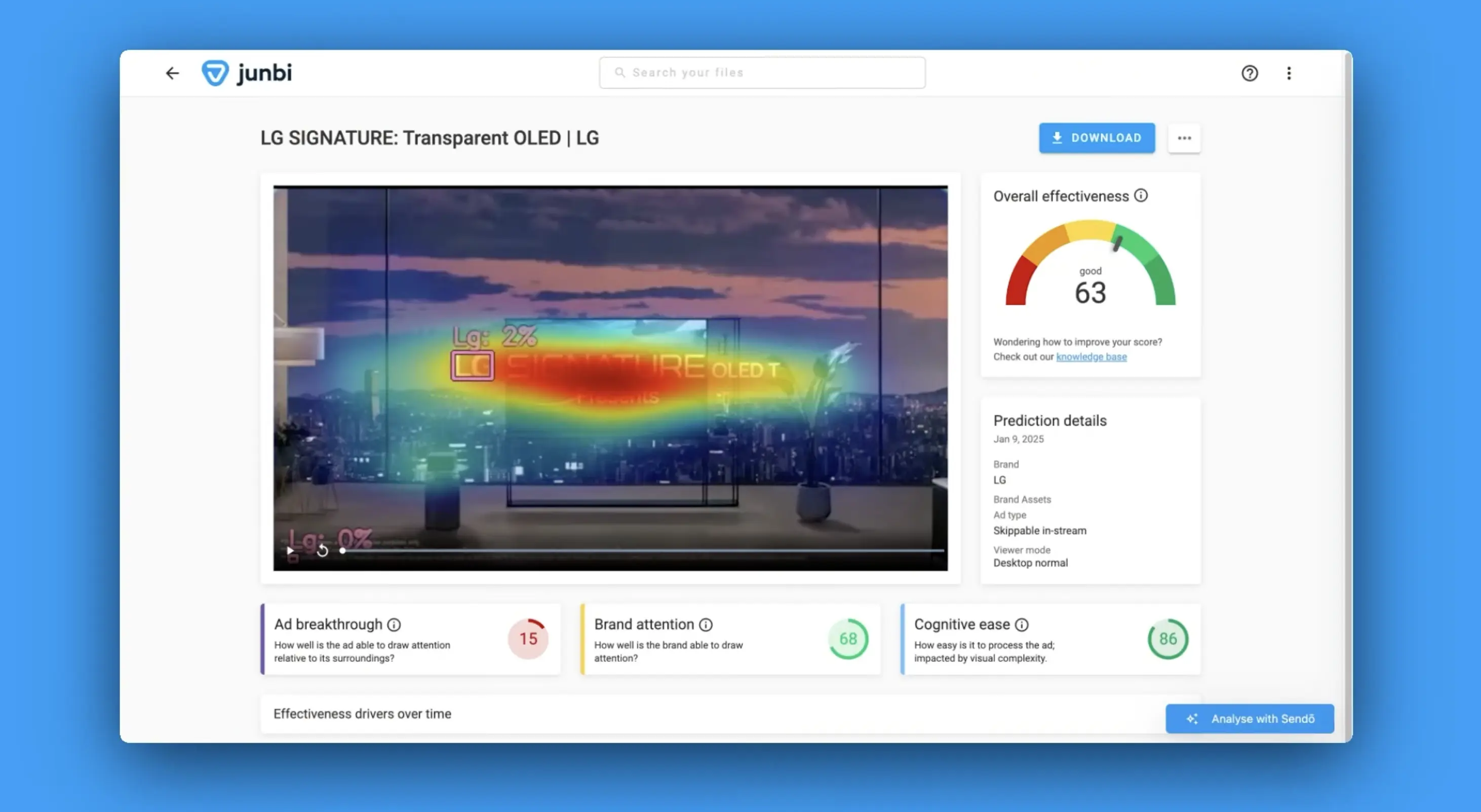
junbi is built for brands and agencies that run video advertising, with a focus on YouTube and connected TV. It analyzes your ad frame by frame and gives second-by-second feedback on the drivers that matter: brand attention, ad breakthrough (how well the ad stands out in its context) and cognitive ease (how easily viewers process what they see). Results can be benchmarked against a large database of real YouTube ads, so you know not only how your ad performs but how it compares with what your audience actually sees. That means you can find the exact moment attention drops, see whether your brand shows up early enough, and test changes before the final cut goes into media.
expoze: predict where attention goes
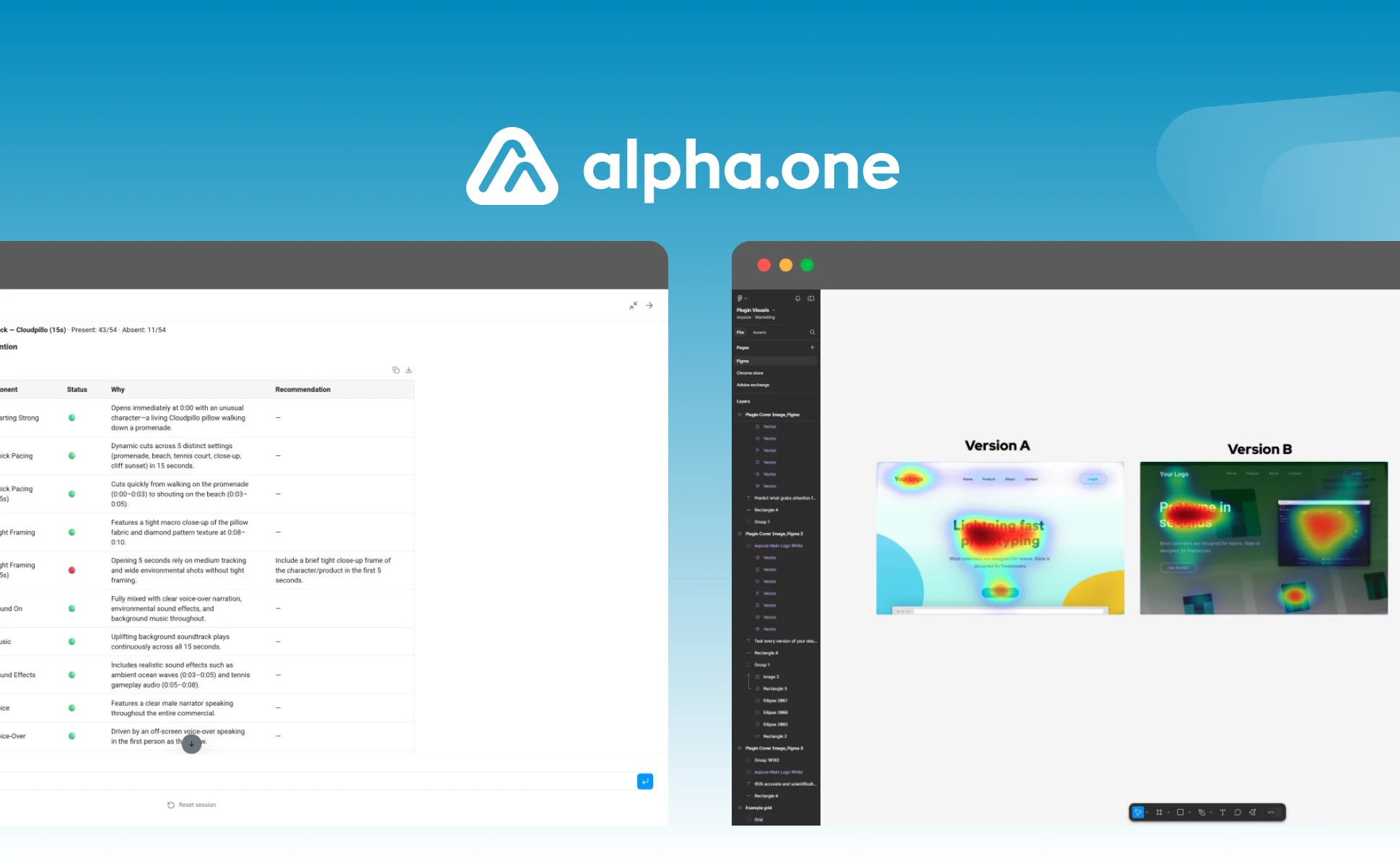
expoze predicts visual attention on images and video, generating heatmaps and attention scores before anything goes live. It is designed for the fast checks that sit inside the creative process: does the headline get noticed, does the product stand out, does the call to action compete with something louder?
The Bottom Line
Testing costs money, and not testing does too, paid for in media budget, missed performance, and lessons learned too late. The difference is that the cost of testing is visible and the cost of not testing is not. Once you start counting both, the decision usually makes itself.
Frequently asked questions
What is the opportunity cost of not testing ads? It is the performance you give up by launching an unverified creative: the extra attention, brand recall and sales effect that a stronger version could have delivered with the same media budget, plus the cost of problems you only discover after launch.
Does pre-testing slow down production? Not with predictive AI, as tools like junbi and expoze return results in minutes, so testing fits inside existing review cycles instead of adding weeks of fieldwork.
Is AI-based testing a replacement for creative judgment? No, it gives creative teams objective evidence about attention, branding and ease of processing, so the decisions are made on data rather than on the loudest opinion in the room.
When in the process should we test? Early and often, use expoze on designs, layouts and key frames while changes are cheap, and junbi on rough and final video cuts before media is booked.
Which ad formats can be tested? expoze works on images and video, while junbi focuses on video, including YouTube formats and connected TV.