

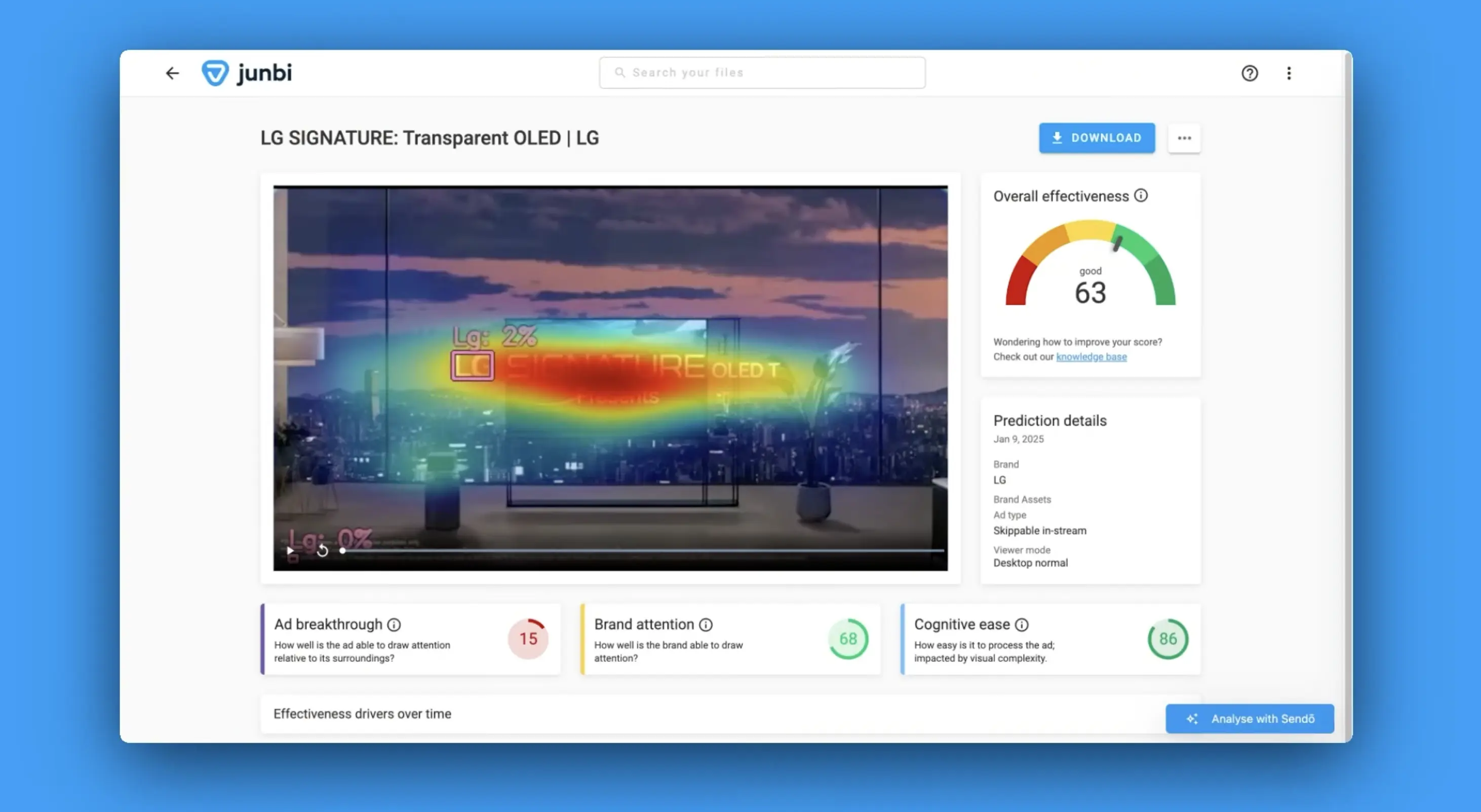

In a junbi prediction for LG Signature’s “Transparent OLED” ad, cognitive ease (86) and brand attention (68) were strong, while ad breakthrough was 15, which brings the overall score to 63. This article reviews what attention research says about breakthrough in the opening seconds and how the findings apply to this ad.
Watch the full junbi review of this ad:
Key Takeaways:
- In junbi, ad breakthrough is the predicted ability of an ad to draw attention relative to its surroundings. Here it is the lowest of the three metrics.
- Experiments show that abrupt visual change, motion and cuts can capture attention automatically, but mainly when attention is not already committed elsewhere (Yantis & Jonides, 1984; Theeuwes, 1991; Lang et al., 1993).
- In eye-tracking data from 31 TV commercials and nearly 2,000 participants, dispersed attention predicted ad avoidance, and central on-screen brand placement increased it (Teixeira et al., 2010).
- In skippable video ads, higher-arousal content has been linked to longer viewing (Belanche et al., 2017). The opening that Sendō describes as slow and static offers little of this.
The Scores
The prediction was run for a skippable in-stream placement, viewed on desktop. Scores are model predictions, not measured viewer behavior.
- Overall effectiveness: 63 (good)
- Ad breakthrough: 15
- Brand attention: 68
- Cognitive ease: 86
The pattern of interest is the gap between metrics, where once viewers are looking, the ad performs well, but the weakness is in drawing the look in the first place.
What Ad Breakthrough Measures
junbi defines ad breakthrough as how well the ad draws attention relative to its surroundings. On YouTube those surroundings include the video title, the recommended videos in the sidebar and any other content competing for the eye. An ad can be well made and still score low if little in it distinguishes it from that context.
Evidence: Attention Capture in the Opening Seconds
Abrupt change captures attention under certain conditions: Yantis and Jonides (1984) showed that abrupt visual onsets can capture attention in visual search. Theeuwes (1991) refined this: onsets and offsets attracted attention when attention was unfocused, but not when participants had been directed to another location in advance. For a skippable pre-roll, where the viewer is often waiting for a chosen video, this suggests an opening needs a clear change of its own to compete. An opening with little change gives this mechanism little to act on.
Cuts and motion trigger orienting responses: Lang (1990) and Lang et al. (1993) examined how structural features of television, such as cuts, produce orienting responses and affect attention and memory. In a review of earlier work, Diao and Sundar (2004) note that animated web ads can elicit orienting responses where static ones may not.
The decision window is short: Industry research by MediaScience, using skin conductance and heart-rate measures, reported that viewers make a go or no-go decision within the first two to three seconds and that attention peaks in that window. This figure comes from industry testing and has not been peer reviewed.
Evidence: Branding and Avoidance
Teixeira, Wedel and Pieters (2010) combined eye tracking with zapping data for 31 commercials and nearly 2,000 participants. Dispersion of attention strongly predicted avoidance. Central on-screen brand position, but not brand size, further increased avoidance. Pulsing brand presence, while keeping total exposure constant, significantly reduced it, both in simulations and in a controlled experiment.
Evidence on brand timing in skippable formats is mixed. A doctoral study from the University of Zaragoza (Pérez-Rueda, 2017) found that showing the brand name before the arousal peak improved recall in skippable formats. Google’s 2015 analysis of YouTube ads, also industry data, found that early branding raised recall and awareness but also raised skip rates, and advised tying the logo to the product rather than floating it on screen. Together these suggest brand timing is a trade-off, and that placement matters as much as timing.
Where LG’s Opening Loses the Viewer
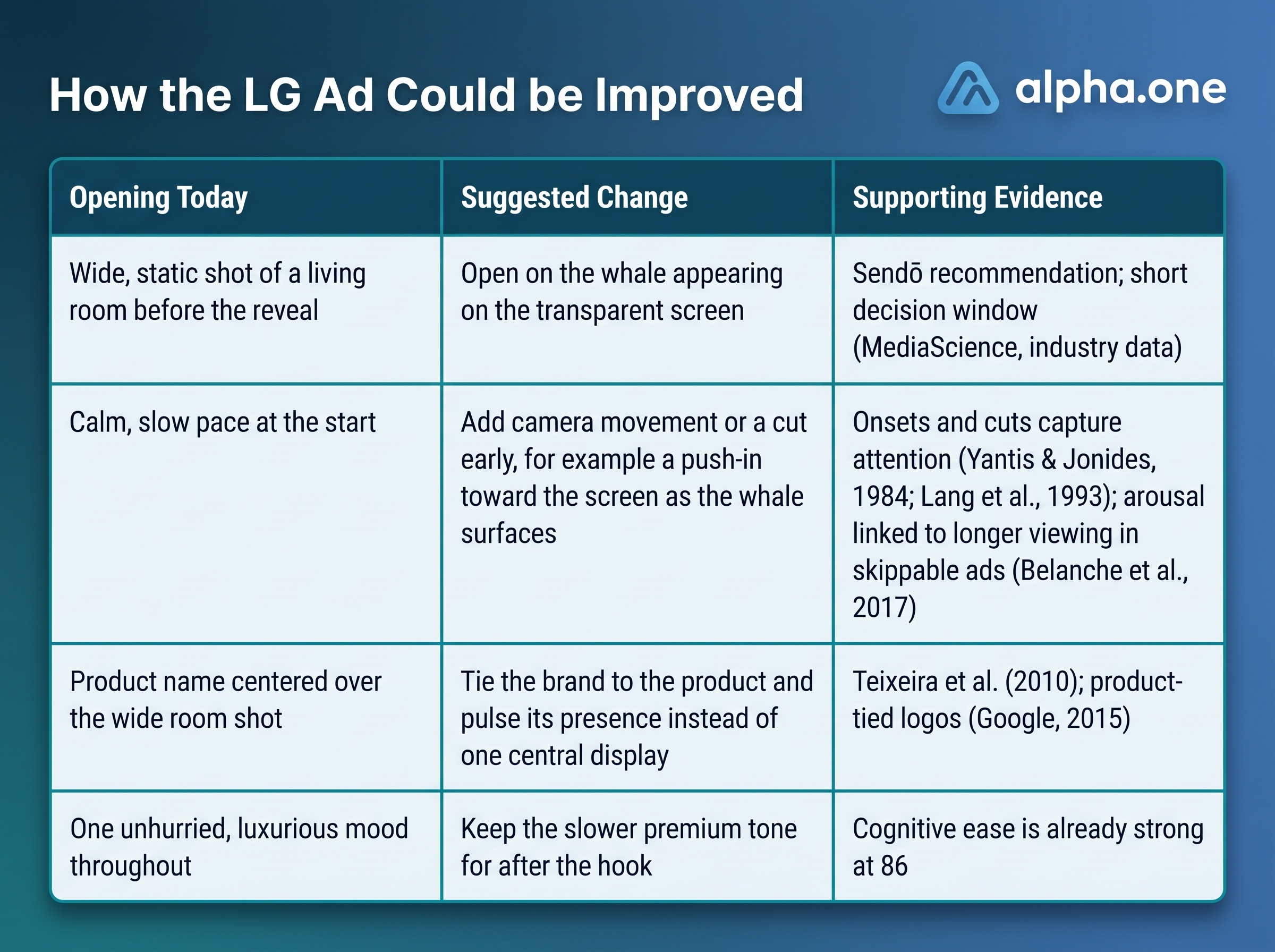
junbi’s Sendō analysis traced the low score to the opening. The ad begins with a wide, static shot of a living room before revealing its main feature, the transparent screen. In the ad, the product name also appears as a centered title over that wide shot, a placement associated with higher avoidance in Teixeira et al. (2010), although that study used TV commercials rather than YouTube.
One further hypothesis, which this prediction cannot test directly: the visual restraint behind the cognitive ease score of 86 may make the opening quieter relative to surrounding content, so the ease of processing and distinctiveness are separate properties.
Example Cases of Strong Openings
The ads below are often cited for their openings. They are illustrative examples, not experimental evidence, and their junbi scores are not reported here.
- Dollar Shave Club, “Our Blades Are F-ing Great”: the founder addresses the camera directly in a warehouse and uses humor from the first moments.
- Volvo Trucks, “The Epic Split”: a recognizable star and a daring stunt create novelty and tension, with the brand message held to the payoff.
- Dove, “Real Beauty Sketches”: opens with an unexplained premise (a forensic artist in a Dove ad) that creates a reason to keep watching.
References
- Belanche, D., Flavián, C., & Pérez-Rueda, A. (2017). Understanding interactive online advertising: Congruence and product involvement in highly and lowly arousing, skippable video ads. Journal of Interactive Marketing, 37, 75–88. https://doi.org/10.1016/j.intmar.2016.06.004
- Diao, F., & Sundar, S. S. (2004). Orienting response and memory for web advertisements: Exploring effects of pop-up window and animation. Communication Research. https://doi.org/10.1177/0093650204267932
- Google / YouTube Insights Team (2015). The First 5 Seconds: Creating YouTube Ads That Break Through in a Skippable World. Think with Google. (Industry data.)
- Lang, A. (1990). Involuntary attention and physiological arousal evoked by structural features and emotional content in TV commercials. Communication Research, 17(3), 275–299. https://doi.org/10.1177/009365090017003001
- Lang, A., Geiger, S., Strickwerda, M., & Sumner, J. (1993). The effects of related and unrelated cuts on television viewers’ attention, processing capacity, and memory. Communication Research, 20(1), 4–29. https://doi.org/10.1177/009365093020001001
- MediaScience. Findings on the first two to three seconds of ad exposure, as reported in “Is ‘The Power of :06 Ads’ a Concern for Broadcast TV?” (RBR). (Industry data.)
- Pérez-Rueda, A. (2017). Understanding new online video advertising: The role of arousal and skippability on ad effectiveness [Doctoral thesis]. Universidad de Zaragoza.
- Teixeira, T., Wedel, M., & Pieters, R. (2010). Moment-to-moment optimal branding in TV commercials: Preventing avoidance by pulsing. Marketing Science, 29(5), 783–804.
- Theeuwes, J. (1991). Exogenous and endogenous control of attention: The effect of visual onsets and offsets. Perception & Psychophysics, 49(1), 83–90. https://doi.org/10.3758/BF03211619
- Yantis, S., & Jonides, J. (1984). Abrupt visual onsets and selective attention: Evidence from visual search. Journal of Experimental Psychology: Human Perception and Performance, 10(5), 601–621.


