


Why Les Binet? Why Now?
The modern advertising industry is suffering from a systemic misunderstanding of basic physics. In pursuit of micro-targeted precision and immediate return on investment (ROI), brand leaders have systematically prioritized short-term efficiency over broad-scale market reach.
Les Binet, former Head of Effectiveness at Adam & Eve DDB and co-author of foundational industry texts such as Marketing in the Era of Accountability (2007) and The Long and the Short of It (2013), argues that this fixation on efficiency is quietly bankrupting commercial enterprise. In his research paper for the IPA, Go Big or Go Home, Binet utilizes empirical econometric analysis to re-establish a core mathematical truth: media scale is the primary engine of commercial growth.
The Physics of Marketing Scale
Marketing Scale vs. Efficiency: Marketing scale is the total weight of paid media exposure delivered across an entire target category, whereas efficiency measures the financial return generated per unit of spend. Empirical regression analysis confirms that budget scale accounts for 80% of campaign effectiveness variance, making scale eight times more influential than tactical ROI optimization.
Key Takeaways
- The 8x Reality: Econometric regression analysis reveals that total media spend accounts for roughly 80% of total effectiveness variation, outranking ROI optimization eight to one.
- The ROI Fallacy: Maximizing efficiency ratios without accounting for scale incentivizes micro-campaigns that yield high ROI percentages but negligible absolute profits.
- The 60-40 Rule Mechanics: Brand building reaches the 95% out-of-market audience to embed long-term memories, whereas sales activation converts the 5% currently in-market.
- The Efficiency Death Spiral: Cutting broad-reach spend improves short-term ROI while shrinking revenue, triggering a cycle of budget cuts that ends in business insolvency.
- Budget Setting Imperative: CMOs must participate in upstream budget setting using predictive econometric modeling rather than accepting passive, top-down allocations.
- Production Dilution: Fracturing budgets across micro-assets or low-cost AI variants inflates production overhead relative to working media, destroying economies of scale.
The Accidental Marketeer: From Quantum Physics to Felix the Cat
Before establishing himself as one of the world's most cited marketing effectiveness researchers, Les Binet trained as a theoretical physicist. In 1981, at twenty-one years old, he was conducting research alongside Professor Peter Higgs at the University of Edinburgh.
"I had achieved my dream, and then I discovered I absolutely hated it," Binet recalls. "Plan A, twenty-one years old, and I had no plan B."
Pivoting away from pure physics, Binet transitioned into epistemology and cognitive science, joining an artificial intelligence team working on early neural network architectures from 1982 to 1984. A temporary three-day consulting assignment at London agency Boase Massimi Pollitt (BMP) to settle student debts unexpectedly turned into a 38-year tenure. As the agency evolved into DDB London and ultimately Adam & Eve DDB, Binet applied his mathematical background directly to human behavior and media mechanics.
"I remember one day in particular," Binet notes. "In the morning I was doing complicated matrix algebra for a telecoms client. In the afternoon I was watching reels of cartoon cats for Felix, cataloguing them by type. I thought: what other job lets you do that?"
That unique blend of rigorous statistical modeling and human psychological analysis eventually yielded The Long and the Short of It (co-authored with Peter Field), establishing the widely cited 60-40 rule of marketing budget allocation.
Activation vs. Brand Building: Revisiting the 60-40 Rule
To understand why modern marketing efficiency metrics misguide business decisions, one must first analyze how advertising influences consumer memory over distinct time horizons. Econometric data demonstrates that short-term performance responses and long-term business growth rely on entirely different cognitive mechanisms.
Sales Activation (Performance Marketing)
- Target Audience: Focuses strictly on the approximately 5% of category buyers active in the market at any given moment.
- Strategic Objective: Prompts immediate transaction behaviors using direct promotional levers.
- Messaging Profile: Relies on rational, functional information, such as product specifications, pricing, promotional coupons, and stock availability.
- Channel Exemplar: Paid search engine marketing (e.g., searching "running shoes," clicking a sponsored link, and completing a transaction).
- Commercial Behavior: Activation drives immediate volume spikes but builds no residual brand equity. When media spend ceases, conversion volume drops immediately to zero.
Brand Building (Mental Availability)
- Target Audience: Reaches broad populations across the remaining 95% of category buyers who are not currently in-market but will enter over the next six to thirty-six months.
- Strategic Objective: Embeds distinctive emotional associations and long-term memory structures.
- Messaging Profile: Focuses on emotional framing, visual storytelling, and general brand positioning rather than technical specifications or immediate pricing.
- Channel Exemplar: Mass media video, linear television, and broad digital display campaigns.
- Commercial Behavior: Activation creates immediate actions; brand building embeds long-term memory structures. Brand advertising ensures that when a consumer eventually enters a purchasing frame, the brand is recalled instantly with positive sentiment.
While Binet and Field's benchmark suggested an average spend balance of 60% brand building to 40% sales activation, Binet emphasizes that organizations often misinterpret this finding as an ironclad rule. The balance shifts based on category dynamics, price points, and market conditions, as documented in their follow-up paper, Effectiveness in Context. However, the underlying truth remains: brand building must lead spend to maintain long-term commercial momentum.
The 8x Rule: Empirical Data vs. CMO Delusion
In his report, Go Big or Go Home, Binet directly tackles the industry's confusion surrounding campaign effectiveness and campaign efficiency.
From a mathematical standpoint, effectiveness represents the absolute displacement of a business outcome (total net profit generated). Efficiency represents the ratio of return relative to effort (Effectiveness divided by Spend, commonly expressed as ROI). To maximize commercial effectiveness, an enterprise requires high efficiency, substantial spend, or ideally both.
When surveying 500 Chief Marketing Officers (CMOs), Binet uncovered a severe structural disconnect between executive perception and historical performance data:
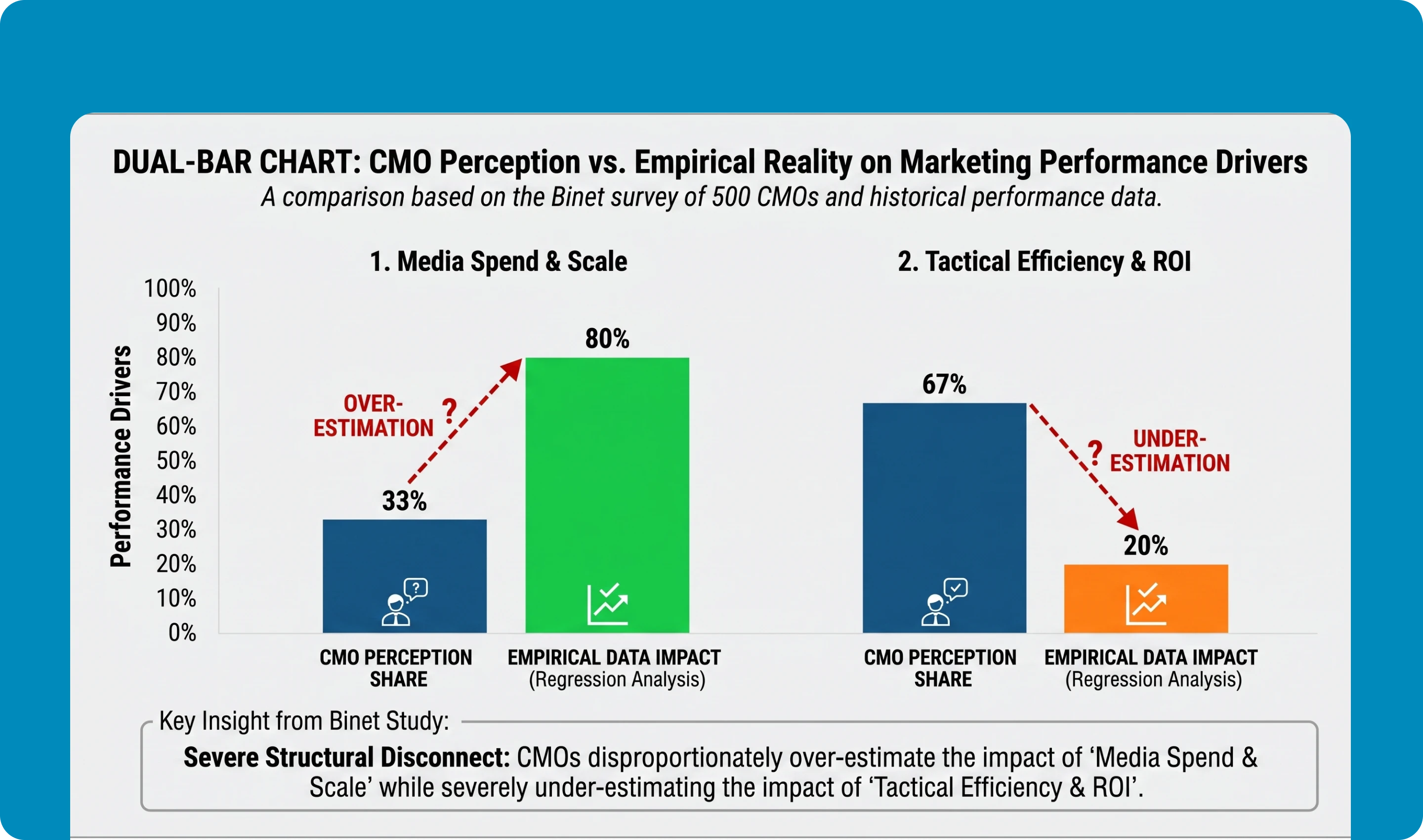
While CMOs believe two-thirds of marketing outcome is governed by efficiency levers like media targeting and tactical optimization, econometric regression modeling across real campaign variations proves that 80% of total effectiveness is determined by overall spend scale.
"Give me a choice between a mediocre campaign with a huge budget and a brilliant campaign with a tiny one, and I’ll take the big budget every time," Binet states. "The best advertising in the world fails without exposure."
A campaign's creative resonance cannot establish mental availability if media scale fails to reach the broader population. Without evaluating broad-reach attention metrics to ensure campaigns capture cognitive focus at scale, even high-performing creative assets remain commercially constrained.
The Mechanics of the Efficiency Death Spiral
Why are marketing leadership teams trapped in an ongoing cycle of hyper-targeting and budget contraction? Binet points to corporate governance structures and misaligned accounting practices within the C-suite.
Many CMOs are excluded from strategic budget setting. Chief Financial Officers (CFOs) often impose static budgets based on arbitrary metrics, such as a fixed percentage of historical revenue or basic inflation adjustments. Lacking financial models that demonstrate how increased spend drives top-line profit, marketing leaders attempt to justify expenditure by maximizing short-term ROI ratios.
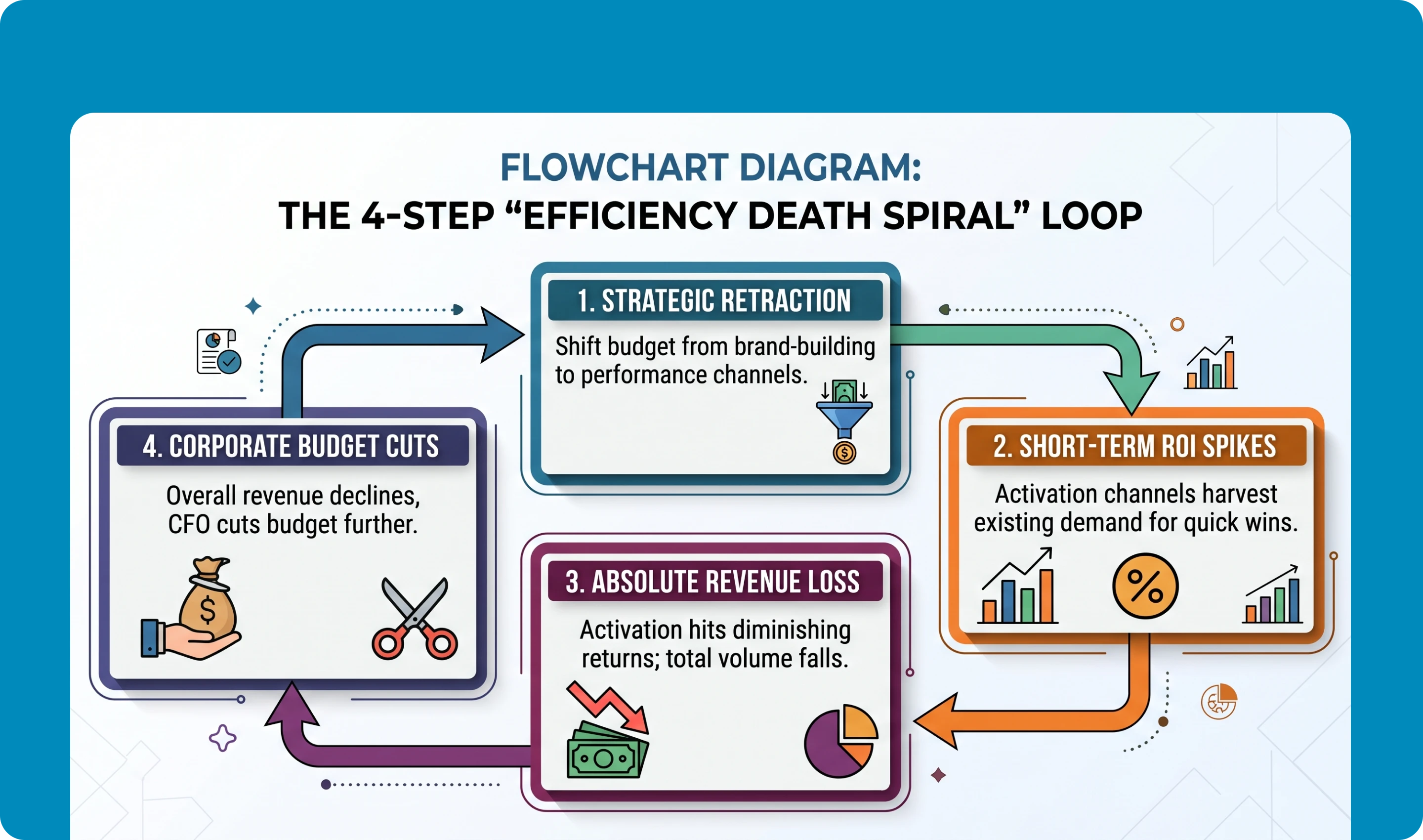
This dynamic initiates the Efficiency Death Spiral:
- Strategic Retraction: The marketing team shifts budget away from broad reach toward tightly targeted performance channels.
- Short-Term ROI Spikes: Because these activation channels harvest existing demand from the 5% in-market audience, conversion ROI metrics rise rapidly.
- Absolute Revenue Loss: Small-scale activation activities suffer from steep diminishing returns. While the ROI percentage looks favorable, total volume falls because the brand has stopped building mental availability among the 95% of future buyers.
- Corporate Budget Cuts: Facing stagnant or declining overall revenue, the CFO reduces the marketing budget further. The marketing department responds by seeking even greater "efficiency" within their reduced budget, further shrinking their market footprint.
Binet highlights the logical extreme of this trajectory:
"The most efficient business is one with no sales, no profit and no staff. Zero over zero is infinite. The most efficient way to run a business is to go bankrupt, that’s perfectly efficient. You can’t optimize your way out of a lack of scale."
Channel Realities: Virality, Influencer Limits, and Mass Reach
When confronted with the necessity of broad reach, brand leaders often point to social media channels, organic virality, or influencer sponsorships as low-cost alternatives to paid mass media. Binet's empirical evaluation highlights the structural limits of these channels.
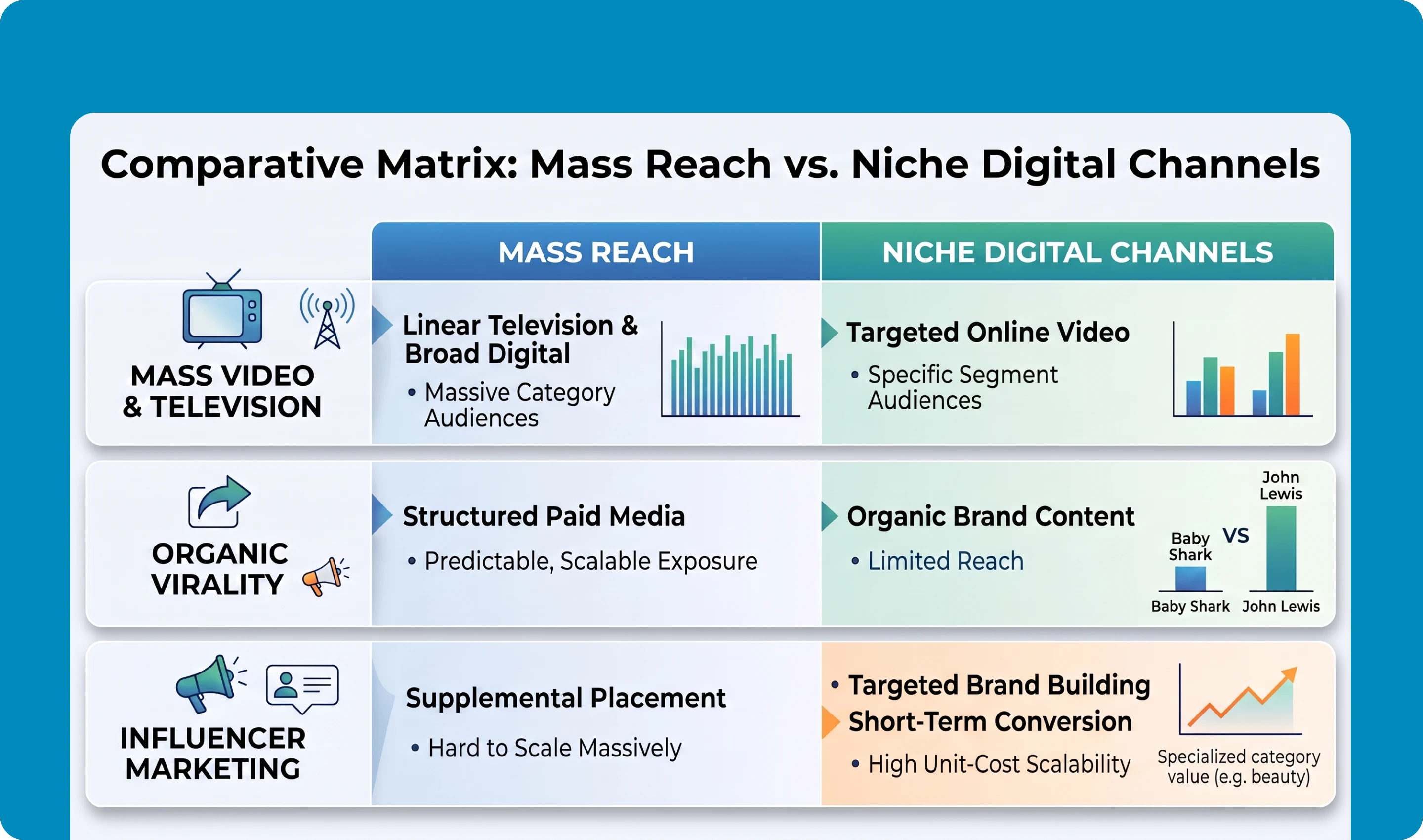
Mass Video & Television
- Linear television and broad-scale digital video continue to reach massive category audiences.
- Reaches the entire potential buyer base across multi-year purchase cycles.
Organic Virality
- Organic reach for brand-generated content remains negligible.
- Even global viral phenomena remain small when compared to structured paid mass media campaigns. For example, the organic reach of Baby Shark over a comparable operating period was dwarfed by a standard John Lewis UK Christmas campaign, which generated five times the exposure weight in half the time.
Influencer Marketing
- Demonstrates average performance for short-term conversion but delivers value for long-term brand building in specialized categories like health and beauty.
- Suffers from poor unit-cost scalability. In media planning terms, influencer sponsorships function similarly to supplemental radio or print placements, useful additions, but structurally incapable of serving as the primary driver of mass category reach.
Production Dilution and the Double-Edged Sword of AI
A prominent debate in modern media strategy centers on creative asset volume. Proponents of a "Lots of Littles" approach argue that brands should deploy hundreds of dynamic creative variations across fragmented digital platforms.
While multi-channel deployment is necessary to navigate modern media fragmentation, Binet warns against production budget dilution. Splintering campaigns into hundreds of bespoke assets inflates fixed production overhead relative to working media spend. If production costs consume a significant portion of the total budget, the campaign loses the economies of scale needed to achieve effective reach. Binet estimates that nearly half of all digital campaigns run at a net loss because asset production expenses eat up the media budget.
Generative AI and Creative Quality
Generative AI tools promise to reduce asset production costs, but Binet cautions against treating cheap content generation as a silver bullet:
"AI is a double-edged sword. Clever people will use it to make themselves cleverer. Dumb people will use it to do more dumb shit at lower prices."
Long-term memory structures are built through creative quality, narrative craft, humor, beauty, and emotional resonance. Flooding digital feeds with low-quality, AI-generated assets that users skip in under three seconds fails to drive long-term brand equity. Managing visual elements and visual complexity remains essential to ensuring creative assets hold viewer attention and build lasting mental availability.
Strategic Application for Marketing Executives
To escape the efficiency trap and rebuild commercial effectiveness, marketing leadership must recalibrate their operational focus:
- Reclaim Upstream Budget Setting: CMOs must move beyond passive budget allocation. Utilize econometric market mix modeling (MMM) and predictive modeling to demonstrate to financial leadership how budget scale expands total enterprise profit.
- Anchor Decisions on the 8x Rule: Present empirical data to board-level stakeholders showing that total spend drives 80% of campaign effectiveness variation. Frame media spend as an investment engine for revenue growth rather than a cost center to be minimized.
- Protect Working Media Budgets: Audit asset production overhead strictly. Ensure dynamic creative variations do not consume the working media budget needed to achieve category-wide exposure.
- Target Total Category Audiences: Avoid over-indexing on narrow audience segments or short-term performance pools. Ensure campaigns maintain broad exposure across the entire target category, including high-spending demographics such as consumers aged 55 and older.
- Optimize Creative Quality for Broad Reach: Pair mass media scale with high-impact creative execution. Drive long-term memory encoding by investing in creative assets designed to capture human attention across broad audiences.
Scale remains the primary engine of commercial growth. While tactical optimization and creative execution help media budgets perform better, building long-term profit requires brands to maintain scale across their target market.

%201.webp)


