
Everyone Watched, Almost No One Looked at the Brand
Two Hollywood stars, a Super Bowl slot and a big production budget: on paper, a recipe for a memorable ad. But when we tested it in junbi as a non-skippable in-stream ad on connected TV, the results told a more complicated story.
Overall effectiveness: 54 (fair)
The ad scored well on Ad breakthrough (88) and reasonably on Cognitive ease (56). However, the score that held it back was Brand attention: 11. Therefore, this post focuses on brand attention, as it shows whether your media spend is actually putting the brand in front of viewers. Watch our full analysis here:
What Does Brand Attention Measure?
Brand attention tells you how well the brand is able to draw attention. It looks at how much viewer attention lands on your brand cues: logos, packaging, products and on-screen text. An ad can grab eyes and still fall short here, as viewers may watch the celebrity, the joke or the story and give the brand very little attention. In this case, a score of 11 means that for most of the ad, the brand was not where viewers were looking.
What Happened in the Uber Eats Ad
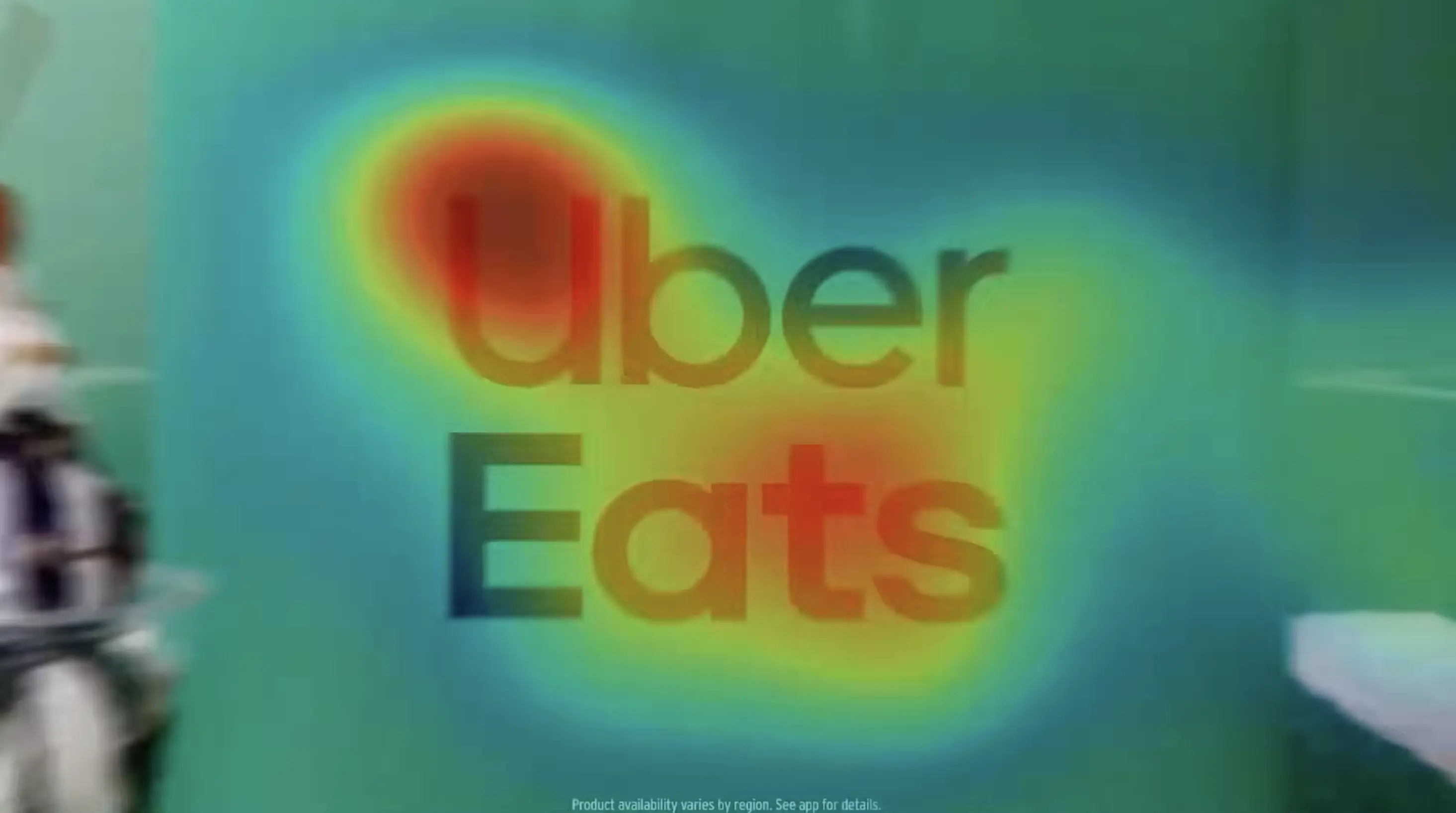
junbi's predictive eye-tracking heatmap shows the pattern clearly:
- Celebrity faces pull the gaze: Matthew McConaughey, Bradley Cooper and Parker Posey draw deep red hotspots whenever they appear. That is attention working exactly as casting intends.
- The brand is in the background: The green Uber Eats delivery bag appears in the kitchen, poolside and on a car hood, but it rarely sits where viewers are looking. Area-of-interest tracking on the bag registers just 0.4% at 0:19, 0.8% at 0:21, 0.2% at 0:27 and 0.0% at 0:33.
- Even the end card barely registers: the bag peaks at just 3.9% (0:57–0:59), next to the line "When football makes you HUNGRY." That is the highest brand attention in the entire ad, and it still arrives too late. Consequently, the story gets the attention, but the brand does not.
Seven Ways to Improve Brand Attention
1. Put the brand where the attention already is
Sendō's verdict on this ad was simple: align peak attention moments with brand cues. Look at your heatmap, find the frames where gaze concentrates (usually a face), and place a brand cue in or next to that spot. If viewers are already looking at a celebrity, the bag, logo or product should be within that same line of sight, not across the frame.
2. Make the brand an active part of the story
A bag sitting on a counter is scenery, while a bag being opened, handed over, held up or reacted to is an event. Eyes follow action, so give your product or packaging something to do in the scene, ideally involving the star.
3. Bring the first brand moment forward
In this ad, the brand barely registers at any point, and only peaks on the end card. On a non-skippable in-stream placement, you have a captive audience, but not a guaranteed one. So, introduce a clear brand cue in the first few seconds and repeat it at intervals, so the brand is tied to the story rather than appended to it.
4. Let the celebrity carry the brand, not compete with it
Famous faces are attention magnets, and that is a feature. But the risk is that they absorb all of it. Therefore, it is better to put the brand on them: a branded jacket, a distinctive prop, a bag in hand, a name in dialogue. Once the star and the brand share the same visual real estate, the star's pull works for you.
5. Increase the size, contrast and distinctiveness of cues
Small, background or off-center cues tend to register near zero. Make the key asset larger and let it contrast with its surroundings. Uber Eats' signature green is a strong asset, but it needs to dominate part of the frame instead of blending into a kitchen or poolside setting.
6. Do not rely on one cue, or on the end card
An end slate is useful, but it cannot do all the work. Spread a mix of cues across the ad: product, packaging, on-screen text, logo and sound. Each one gives viewers another chance to connect the story with the brand.
7. Test, adjust and test again
Brand attention is easy to fix once you can see it. Re-cut the ad with a repositioned cue or an earlier logo moment, run it through junbi again and compare AOI percentages frame by frame. Try variants for different placements, since a brand cue that works on connected TV may need to change for a smaller screen.
A Checklist Before you Lock your Cut
- Where is the heatmap hottest, and is any brand cue in that spot?
- When does the brand first receive meaningful attention?
- Is the brand doing something, or just being there?
- Could a viewer name the advertiser without the end card?
- Does your best-performing moment for attention also work for the brand?
The Takeaway
Attention is only valuable when it lands on something worth remembering. The Uber Eats ad shows how star power and fast scene changes can win the eye while leaving the brand behind. With junbi, you don't see what actually looks good, as you see what actually performs and where to improve. Want to see how your own ad scores on brand attention? Run it through junbi and ask Sendō for the verdict.