

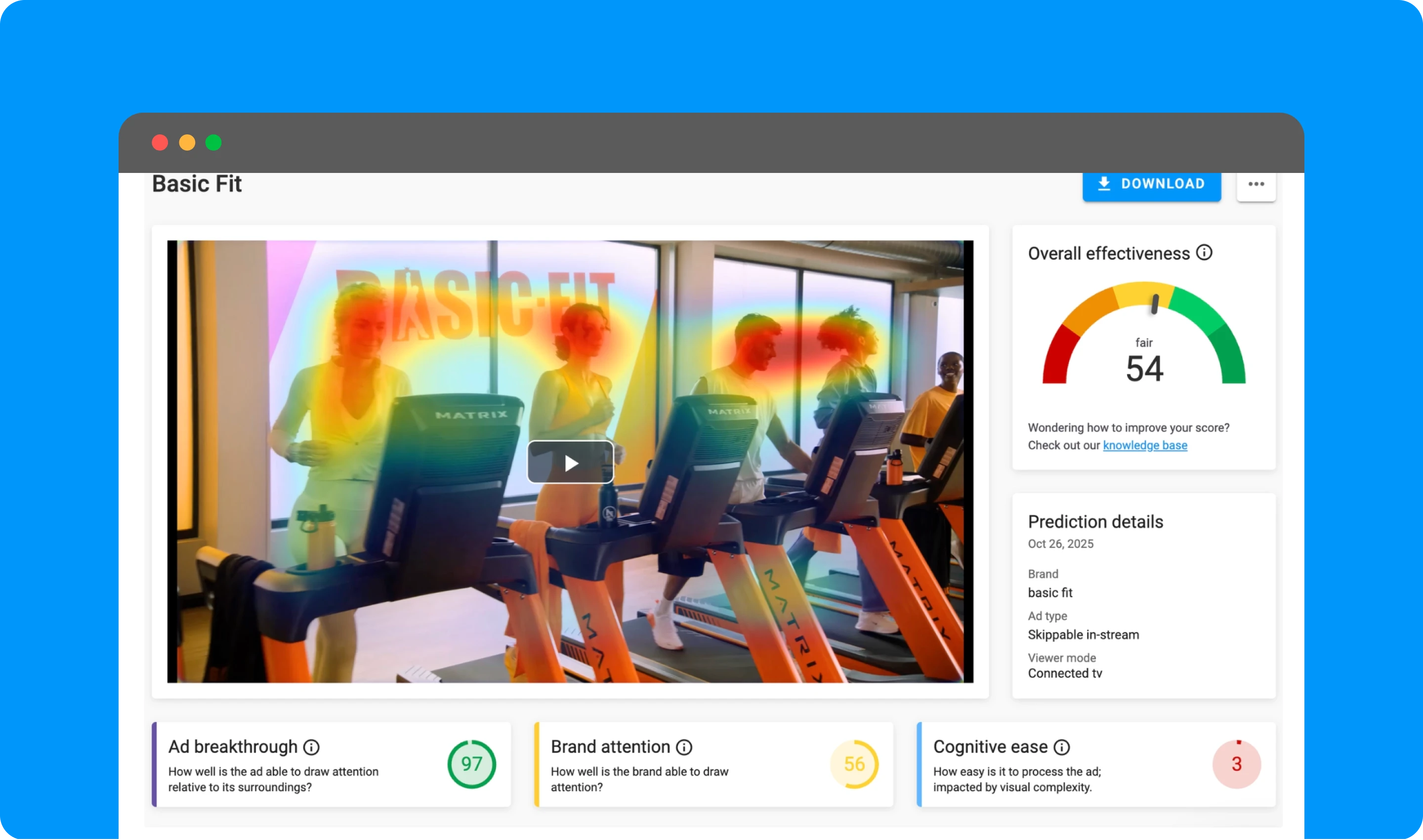

Our eyes are drawn to faces first, but, in video advertising, that reflex can quietly work against your brand’s recall. In this edition of junbi in action, we put a Basic-Fit ad through predictive eye-tracking and tested it as a skippable in-stream ad on connected TV. The ad does something very well and something less well, and attention research helps explain both. The less well part is known as the vampire effect.
Watch the full analysis here:
The Result at a Glance
junbi gave the ad an overall effectiveness score of 54, where three scores sit behind that number:
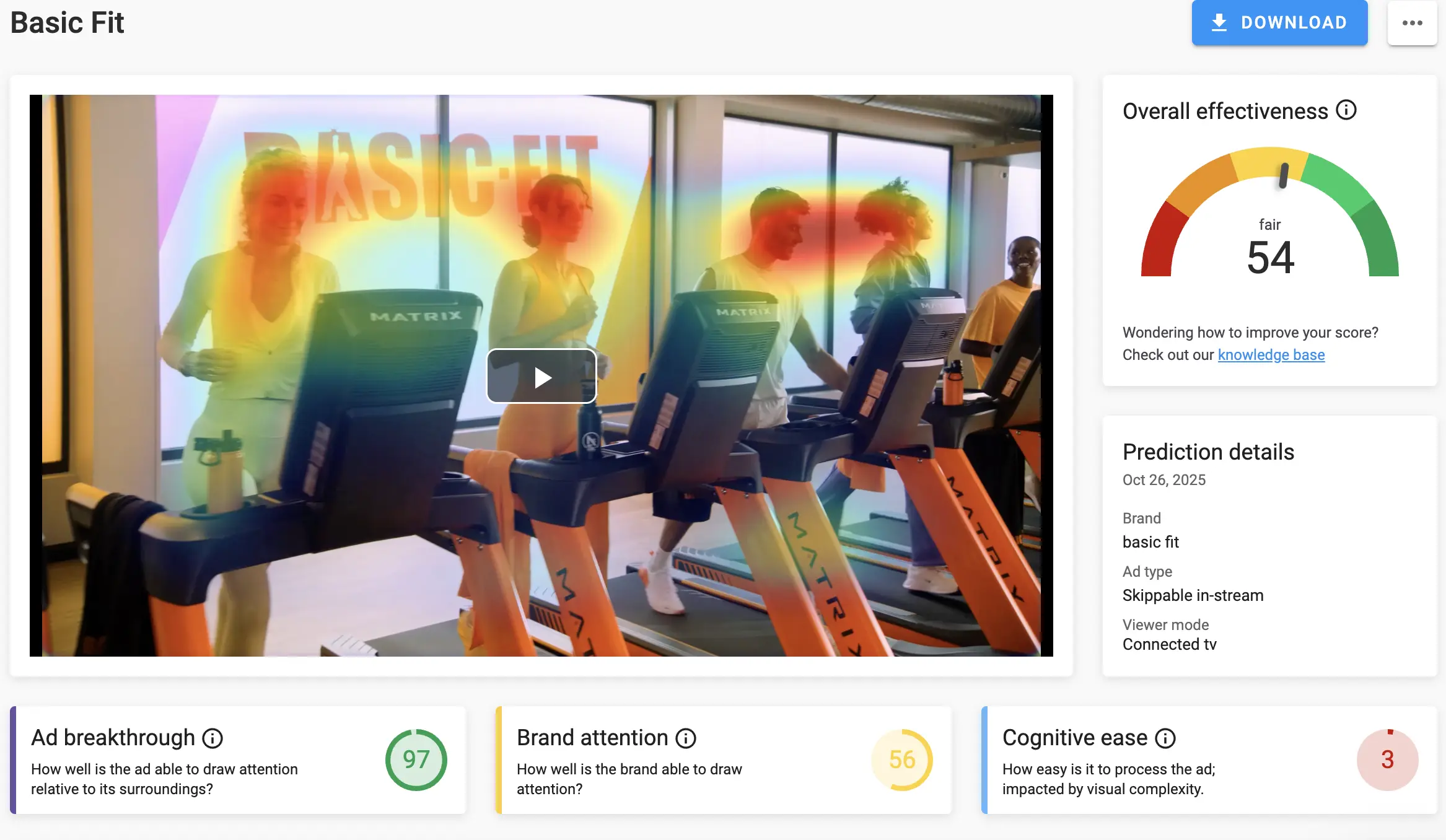
Ad breakthrough (97): the Ad Stands Out Instantly
Fast cuts and saturated orange tones make the spot stand out on screen almost immediately. In a skippable format, this matters, as viewers decide quickly, and an ad that does not break through in the opening seconds has little chance to do anything else.
Context shapes this as well, as the environment an ad runs in affects how much attention it gets, not just the creative. In the AdGazer study, context explained roughly a third of ad attention and a fifth of brand attention. This is why we tested the spot in the placement it will actually run in.
Brand Attention (56) and the Vampire Effect
In the gym scenes, the predicted gaze data shows hot clusters sticking to the runners’ faces. The brand cues in those scenes barely register:
- The logo at 0:00: 9.8% of attention
- The massage chair: 0.1%
- The wall signs: 0.0%
- The orange end slate (0:18–0:20): 56.7%
The brand breaks through at the very start and again on the end slate, but throughout the gym scenes, it is almost invisible. In advertising research, the vampire effect describes a creative element overshadowing the brand it’s meant to promote. The term comes from work on celebrity endorsers, as it is defined as a decrease in brand recall for an ad featuring a celebrity endorser compared with the same ad featuring an unknown but equally attractive endorser. But we use the term more broadly here, as an analogy for any face that absorbs the attention a brand cue needed.
Two findings help explain what junbi shows: first, faces are strongly attention-grabbing. In eye-tracking experiments on natural scenes, observers fixated on a face with a probability of over 80% within their first two fixations, even when not told to look for anything in particular. Second, the original vampire-effect experiments, with 4,970 respondents in total, found that the effect can be avoided under the right conditions, such as high endorser–brand congruence or a strong cognitive link between the celebrity and the brand. But faces are not the problem, as people connect with people, and that connection is valuable. The risk is that the face absorbs attention without passing any of it to the brand.
The practical lesson from this research is to link the brand and the face, as a smaller, more recent study suggests that integrating brand elements throughout an ad, instead of treating them as a separate component, can help mitigate the effect. That study is small (35 participants), so the hypothesis is worth testing.
Branding also does not need much time to work, but it does need distinctiveness. A study of digital video ads found that ads can be recalled after just 1.5 seconds, but only when distinctive brand assets are present.
Cognitive Ease (3): Too Much to Take In
The lowest score is the most striking: 3 out of 100. Between fast edits, multiple athletes and promotional text, the visual complexity makes the scene hard to take in. One frame shows the text “SPORT NU 5 WEKEN GRATIS” (“five weeks free”) over busy gym-floor action at 0:16–0:17.
Offers are usually where a message needs the most clarity, as when several things compete for the same moment, viewers struggle to process any of them. Research on clutter suggests that standing out and being easy to take in are different challenges: original ads drew more attention to the advertised brand. This ad solves the first challenge and struggles with the second.
The Trade-Off: Breakthrough vs. Brand Attention
The timeline chart tells the most important part of the story. Toward the end of the spot, ad breakthrough drops to about 25% just as brand attention spikes to 100% on the end slate.
This is a trade-off, not a flaw, as a simple, brand-led end slate is easy to look at, so it earns attention. It also stops being a high-impact, attention-grabbing moment. The fast, colourful action earns attention, and the calm slate converts it into brand attention.
The creative challenge is balance, where research on low-attention viewing reminds us that high attention isn’t the only valuable kind: Nelson-Field and Ewens found that the greatest uplift in sales impact comes when a viewer moves from a pre-attentive state to low attention. For a skippable ad on connected TV, brand cues should work even for viewers who are only half-watching.
What Could Be Tested Next
Based on the data, these are possible changes for the ad:
- Link the brand to the faces: Put distinctive brand assets (colour, logo, apparel) where attention already lands.
- Keep the brand present during the gym scenes, not just at the start and end.
- Simplify busy moments: Avoid layering promotional text over busy action, and consider moving the offer to the end slate.
- Protect what works: Keep the fast cuts and saturated orange that drive the 97.
- Retest the revised edit: Check whether the changes lift brand attention without giving up breakthrough.
Test your Ads Before you Spend
Great creative can still lose attention in the places that matter. junbi shows you where, second by second, so you can fix it before media spend goes live.
Want to learn more? This is part of a 'junbi in Action' series, where we previously analyzed LG's ad performance here.
References
- Ye, J., Wedel, M., & Pieters, R. (2025). Improving contextual advertising with theory-informed machine learning. Journal of Marketing.
- Erfgen, C., Zenker, S., & Sattler, H. (2015). The vampire effect: When do celebrity endorsers harm brand recall? International Journal of Research in Marketing, 32(2), 155–163. doi:10.1016/j.ijresmar.2014.12.002
- Cerf, M., Harel, J., Einhäuser, W., & Koch, C. (2007). Predicting human gaze using low-level saliency combined with face detection. Advances in Neural Information Processing Systems 20 (NIPS 2007), 241–248.
- Pieters, R., & Wedel, M. (2004). Attention capture and transfer in advertising: Brand, pictorial, and text-size effects. Journal of Marketing, 68(2), 36–50.
- Soliman, M., & Taher, A. (2025). What was that brand? Exploring and expanding vampire effect theory in digital advertising. Conference presentation, BAMC 2025.
- Amplified & VCCP Media (Nelson-Field, K., & Parrish, W.). Distinctive brand assets and attention in digital video advertising. Reported in The Media Leader UK.
- Pieters, R., Warlop, L., & Wedel, M. (2002). Breaking through the clutter: Benefits of advertisement originality and familiarity for brand attention and memory. Management Science, 48(6), 765–781.
- Nelson-Field, K., & Ewens, K. Low-attention processing and its relationship to sales. Admap (with Dentsu Aegis Network’s Attention Economy Initiative).


